Many years ago, I was in Los Angeles for a Neuroscience conference. While there, I stopped by to visit a cousin who I had never met. Clare was the first cousin of my maternal grandfather (so she was my first cousin, twice removed). She was 90 years-old and living in assisted living. We met for early supper and then took a walk around the garden. I felt like I had known her for years! Not an awkward first visit, as I supposed would happen. It was very easy to converse with her on a multitude of topics, and we had many opinions in common, which surprised me. That’s when it dawned on me that DNA is a potent force, producing a certain degree of resonance between individuals.
As the years passed, I noticed the energy of large family gatherings. Sure, there were frictions and overwhelm with so much energy. But the strength, the balance, the wholeness of the tribal gathering- I felt for weeks afterwards! What was this potent family force? Here is some positive group energy from one of my own family get-togethers:
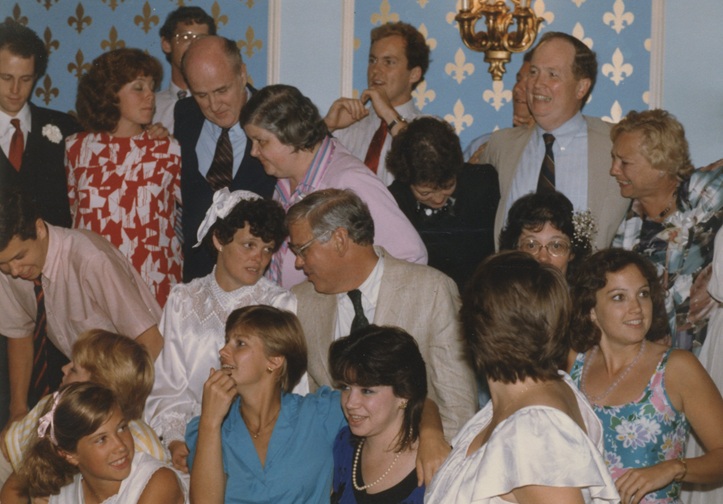
If every cell in our body has unique DNA and each cell is radiating energy, then the frequencies of our DNA, our cell frequencies, are radiated throughout our biofield. We are emitting our DNA/cell frequencies all the time. With blood relatives, we share a high degree of DNA, so the group resonance may be, in part, DNA resonance. We feel strong and healthy in a family resonant field. We resonate with genetic relatives who we have not yet met.
The Navajo Native American tribe carries this understanding of family resonance a step further. When one member of their family is ill, they will hold a healing ceremony with family in attendance, recognizing the healing power of family. Not just one or two family members, but the whole family for several days. According to the Navajo, illness is a disharmony involving the patient’s mind, body, spirit, and social relations – not just the physical body. Therefore, to bring the individual back into balance, a sacred healing ceremony is needed. According to Koithan and Farrell (2010), indigenous Native Americans believe that, “the more people that are present, the greater the healing energy”.
- Likewise, in Western medicine, both family and spirituality are recognized as helpful in terms of health outcomes. In a meta-analysis of 52 peer-reviewed studies, Hartmann et al. (2010) found that family involvement during physical illnesses, such as cardiovascular disease, cancer and arthritis, resulted in significantly better health than standard treatment for all outcomes. The mean overall effect size was 0.32 for the patients’ physical health, which the authors noted is not large, but is a stable, long-term effect across different studies. Research also indicates that having a regular spiritual practice (e.g., participating in religious services) may increase longevity (Gillum et al, 2008; Dominguez et al., 2024). Group resonance may be involved in both family support and spiritual practice.
Family DNA resonance, although powerful, does not account for all cases of group resonance. In a previous blog, I described the group resonance at a Monroe Institute Guidelines program, where I recorded high-magnitude, magnetic field oscillations . Similarly, I noted unusual oscillations at a large group spiritual healing session with healer Ron Roth. Magnetic field activity may be a good measure of group resonance. During Healing Touch magnetic field recording sessions, I noted particular frequencies that predominated in particular sessions, using Fourier Power spectra analysis. Perhaps with resonant groups and families, we may observe the spiking of particular frequencies in the magnetic field which could be an indicator of resonance.
What about dissonance? While recording magnetic field activity in the lab one day, there happened to be friction and tension between laboratory workers. The phrase, “you could cut the tension with a knife”, aptly described what I felt in the room. The magnetic field recording showed jagged peaks, not the beautiful waves of healing energy. So dissonance is as important to measure as resonance!
Magnetic field activity in a room may be an indicator of how well a group is getting along. Imagine if they recorded MF activity during important negotiations – the true feelings and emotions of those involved would be revealed. We could see if a certain degree of group resonance had been achieved.
References
Dominguez LJ, Veronese N, Barbagallo M. The link between spirituality and longevity. Aging Clin Exp Res. 2024 Feb 11;36(1):32. doi: 10.1007/s40520-023-02684-5. PMID: 38341843; PMCID: PMC10859326.
Gillum RF, King DE, Obisesan TO, Koenig HG. Frequency of attendance at religious services and mortality in a U.S. national cohort. Ann Epidemiol. 2008 Feb;18(2):124-9. doi: 10.1016/j.annepidem.2007.10.015. PMID: 18083539; PMCID: PMC2659561.
Hartmann M, Bäzner E, Wild B, Eisler I, Herzog W. Effects of interventions involving the family in the treatment of adult patients with chronic physical diseases: a meta-analysis. Psychother Psychosom. 2010;79(3):136-48. https://doi.org/10.1159/000286958. Epub 2010 Feb 20. PMID: 20185970.
Koithan M, Farrell C. Indigenous Native American Healing Traditions.
J Nurse Practitioners. 2010 Jun 1;6(6):477–478. https://pmc.ncbi.nlm.nih.gov/articles/PMC2913884/